
When it comes to finding the best moisture meters for concrete, you can’t go wrong with top picks like the FLIR MR60, C555 Pinless Concrete Moisture Meter, and Tramex CME5. These models combine accuracy, durability, and user-friendly features that make moisture detection easy. Lightweight designs and built-in alarms enhance portability and usability on the job site. If you’re keen on making an informed decision, keep exploring the features and benefits of these essential tools.
FLIR MR60 Moisture Meter Pro

The FLIR MR60 Moisture Meter Pro is ideal for professionals in construction and remediation who need reliable moisture readings in various materials, including concrete. This versatile tool features both pin and pinless measurement options, providing accuracy in different scenarios. It’s designed for ease of use, especially in non-destructive tests. The backlit display guarantees readability, even in low-light conditions. While it offers pre-calibrated settings for concrete and other building materials, be aware that metal interference can affect readings. Overall, its durability and portability make it a top choice for moisture mapping and inspections in your projects.
Best For: Professionals in construction and remediation requiring accurate moisture readings across various materials.
Pros:
- Versatile measurement options with both pin and pinless capabilities.
- Durable and portable design, able to withstand a 3-meter drop.
- Highly readable backlit display for use in low-light conditions.
Cons:
- Metal interference can lead to inconsistent readings.
- Bluetooth feature and FLIR Tools app may have reliability issues.
- Not effective on plaster, potentially resulting in false readings.
C555 Pinless Concrete Moisture Meter

For professionals and DIY enthusiasts looking for an efficient way to measure moisture in concrete, the C555 Pinless Concrete Moisture Meter stands out with its quick, non-destructive readings. Weighing just 1.48 pounds and measuring 5.75 x 3 x 1 inches, it’s easy to handle. This battery-powered device comes with a 9V battery and can also measure moisture in brick and gypsum. Its backlit screen guarantees visibility in low-light conditions, while the built-in alarm alerts you when moisture levels exceed 0.0% to 6.9%. With a solid 4.3-star rating, users appreciate its accuracy and reliability, making it a top choice.
Best For: Professionals and DIY enthusiasts seeking an efficient and reliable tool for measuring moisture in concrete, brick, and gypsum.
Pros:
- Quick and non-destructive moisture readings make it easy to use on smooth surfaces.
- Backlit screen enhances visibility in low-light conditions for easy reading.
- Built-in alarm alerts users to moisture levels exceeding 0.0% to 6.9%, ensuring timely action.
Cons:
- May not be as effective on rough or uneven surfaces due to its pinless design.
- Limited to measuring moisture in specific materials (concrete, brick, and gypsum).
- Battery-powered design means reliance on battery life for continuous use.
TopTes Digital Moisture Meter TS-630

Looking for a reliable tool to assess moisture levels in materials like firewood and drywall? The TopTes Digital Moisture Meter TS-630 is an excellent choice. Its large 2.25-inch LCD display shows moisture percentages with a handy bar graph. With a tri-color backlight—green, orange, and red—you’ll quickly gauge moisture levels at a glance. This pin-type meter features seven calibration scales and operates without needing calibration, ensuring accurate readings. Plus, the auto shut-off function saves battery life. You’ll appreciate the included accessories, like test pins and a carry pouch, making it convenient for all your moisture testing needs.
Best For: Homeowners, contractors, and woodworking enthusiasts who need an accurate and easy-to-use moisture meter for assessing moisture levels in materials like firewood and drywall.
Pros:
- High precision multi-material sensor for accurate readings across various materials.
- Tri-color backlight for quick visual assessment of moisture levels.
- Convenient auto shut-off function to extend battery life.
Cons:
- Pin-type design may leave small holes in softer materials.
- Limited to a maximum moisture range of 57%, which may not cover all materials.
- Requires batteries, which may need replacement over time.
Klein Tools ET140 Pinless Moisture Meter for Non-Destructive Moisture Detection

Detecting moisture without causing damage is essential for professionals and DIY enthusiasts alike, making the Klein Tools ET140 Pinless Moisture Meter an excellent choice. This device uses electromagnetic field (EMF) technology to detect moisture in materials like drywall, wood, and masonry up to 3/4-inch below the surface. It measures relative moisture content, helping you identify leaks and flooding. The reverse-contrast display and nine LED bars make reading moisture levels easy. Additional features include a hold function, low battery indicator, and auto-power off for convenience. The kit comes complete with a battery and protective drop cover, ensuring durability and ease of use.
Best For: Professionals and DIY enthusiasts looking for a reliable, non-destructive tool to detect moisture in various materials.
Pros:
- Non-destructive: Uses EMF technology to detect moisture without damaging surfaces.
- User-friendly display: Features a reverse-contrast display and LED indicators for easy reading.
- Convenient features: Includes hold function, low battery indicator, and auto-power off for enhanced usability.
Cons:
- Limited depth detection: Only detects moisture up to 3/4-inch below the surface.
- Calibration required: May need calibration for different materials for accurate readings.
- Battery dependent: Requires a 9V battery, which may need frequent replacement if used regularly.
Tramex Concrete Moisture Encounter CME5 Meter
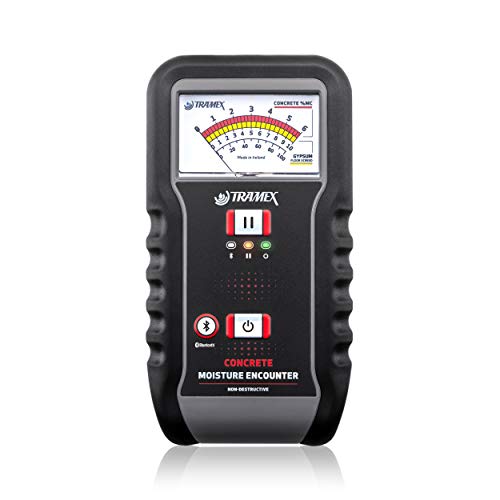
The Tramex Concrete Moisture Encounter CME5 Meter stands out as an essential tool for construction professionals and flooring specialists who need reliable, non-destructive moisture measurements in concrete. This analog meter provides instant quantitative readings, measuring moisture content to a depth of approximately 3/4 inch (20 mm) and offering Carbide Method equivalent readings. With the optional moisture probe, you can extend your measurements down to 4 inches (100 mm). Its durable design allows for visual mapping of moisture levels, while Bluetooth connectivity lets you geotag, timestamp reports, and share photos, ensuring you stay organized and informed throughout your projects.
Best For: Construction professionals and flooring specialists requiring accurate and non-destructive moisture measurements in concrete.
Pros:
- Durable and ergonomic design for easy handling and visual mapping of moisture levels.
- Instant quantitative measurements with Carbide Method equivalent readings for accurate assessments.
- Bluetooth connectivity for geotagging, timestamping reports, and sharing photos for improved project management.
Cons:
- Limited to measuring moisture content up to 3/4 inch (20 mm) without the optional probe.
- Analog display may not provide the same ease of use as digital meters for some users.
- Additional costs for the optional moisture probe may be a drawback for budget-conscious professionals.
General Tools MMD4E Digital Moisture Meter
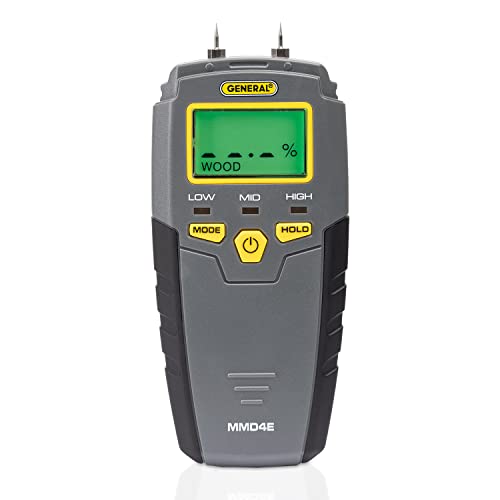
For anyone involved in construction or home improvement, the General Tools MMD4E Digital Moisture Meter stands out as an essential tool. This pin-type moisture tester quickly detects moisture levels in wood, drywall, and concrete, preventing harmful mold growth. With a broad measurement range from 1.5% to 33% for concrete, its backlit LCD displays large digits for easy reading. You’ll appreciate the audible alerts and the HOLD button for easy reference. Plus, the protective cap doubles as a calibration checker. Operating on a convenient 9V battery, this meter helps you work smarter and achieve accurate results every time.
Best For: Homeowners, contractors, and DIY enthusiasts looking for a reliable tool to detect moisture levels and prevent mold growth.
Pros:
- High accuracy with a broad measurement range for various materials including wood and concrete.
- User-friendly design with a backlit LCD, audible alerts, and a HOLD button for easy reading.
- Convenient protective cap that also serves as a calibration checker.
Cons:
- Requires a 9V battery which may need to be replaced frequently.
- Pin-type design may not be suitable for all surfaces or materials.
- Limited to moisture detection and does not provide additional environmental readings.
C555 Pinless Concrete Moisture Meter
Professionals in construction and flooring installation will find the C555 Pinless Concrete Moisture Meter an essential tool for ensuring project success. This lightweight device, weighing just 1.48 pounds, delivers quick, non-destructive moisture readings on smooth concrete. It’s perfect for locating hotspots and measuring moisture in various materials like brick and gypsum. With a backlit screen, you can easily read measurements in low-light conditions. The built-in alarm alerts you when moisture levels exceed 0.0% to 6.9%. Plus, it comes with a rubber protective boot and carrying case, making it a reliable choice for any job site.
Best For: Professionals in construction and flooring installation who require accurate moisture readings for various materials.
Pros:
- Quick, non-destructive moisture readings save time during assessments.
- Built-in alarm for moisture levels provides immediate alerts for potential issues.
- Lightweight design and included carrying case enhance portability and convenience on job sites.
Cons:
- Limited to measuring moisture in specific materials (concrete, brick, gypsum) which may not meet all user needs.
- Battery-powered operation may require frequent battery replacements for continuous use.
- Customer ratings indicate room for improvement, as some users may have higher expectations for accuracy.
Factors to Consider When Choosing Moisture Meters for Concrete
When choosing a moisture meter for concrete, you’ll want to focus on several key factors. Measurement accuracy and reliability are essential, as well as the meter’s ability to perform non-destructive testing. Don’t forget to take into account user-friendly features and portability to guarantee it fits your needs.
Measurement Accuracy and Reliability
Choosing the right moisture meter for concrete hinges on understanding its measurement accuracy and reliability. Look for meters that provide consistent readings under varying conditions, such as changes in temperature and humidity. Models with built-in alarms can alert you when moisture levels exceed certain thresholds, enhancing your ability to address potential issues. Calibration settings for different materials, including concrete, improve precision, guaranteeing you get accurate results for your specific needs. While non-destructive testing is essential for surface integrity, consider features like Bluetooth connectivity, which can help you log and track moisture data over time. By focusing on these factors, you’ll make sure that your moisture meter delivers reliable and precise measurements.
Non-Destructive Testing Capability
While evaluating moisture meters for concrete, non-destructive testing capability is a key factor that shouldn’t be overlooked. These meters utilize electromagnetic field (EMF) technology, allowing you to measure moisture content without penetrating the surface. This feature is particularly beneficial for materials like concrete, as it enables you to assess moisture levels up to 3/4 inch (20 mm) deep without causing damage. Many models come equipped with built-in alarms, alerting you when moisture levels exceed safe thresholds. This enhances your ability to monitor conditions effectively. Additionally, the capacity to quickly locate hotspots for moisture testing optimizes your testing strategy, ensuring accurate assessments and helping you prevent moisture-related issues in your construction or flooring projects.
Temperature and Humidity Measurement
Non-destructive testing capabilities provide a solid foundation for evaluating moisture in concrete, but understanding temperature and humidity is just as important for accurate readings. Moisture meters designed for concrete often measure ambient temperature and humidity, as these factors greatly impact moisture content. Accurate temperature readings are essential since they influence the drying process of concrete and material behavior. Additionally, humidity levels can vary moisture content, making reliable humidity readings crucial. The interaction between temperature and humidity can either exacerbate or alleviate moisture issues, so simultaneous monitoring is important. Many moisture meters even feature built-in alarms to alert you when moisture levels exceed certain thresholds, which can be influenced by surrounding conditions.
User-Friendly Display Features
How can you guarantee accurate moisture readings with your concrete moisture meter? A user-friendly display is essential. Look for a backlit screen that guarantees readability in low-light conditions, making it easy to check moisture levels anytime. Visual indicators, like color-coded alerts—green for low moisture and red for high—allow for quick assessments at a glance. A large LCD with high-contrast digits enhances visibility, ensuring you can interpret readings rapidly. A hold function is also beneficial, letting you freeze the display for easy reference, especially in tricky environments. Additionally, some models offer audible alarms to alert you when moisture levels exceed a set threshold, boosting usability during inspections and guaranteeing you don’t miss critical changes.
Portability and Weight Considerations
A moisture meter’s user-friendly display features make it easier to monitor moisture levels, but portability and weight also play a significant role in your choice. When you’re on a job site, lighter models enhance mobility, making it easier to carry and use throughout your tasks. Compact designs are especially beneficial, as they fit snugly in tight spaces and are simpler to store. Opting for battery-powered meters removes the hassle of finding a power source, allowing you to take measurements wherever needed. Additionally, look for models with carrying cases or protective boots for safe storage during transport. An ergonomic grip design can also improve handling, ensuring you’re comfortable during extended monitoring sessions.
Calibration and Adjustment Options
While selecting a moisture meter for concrete, it is crucial to take into account its calibration and adjustment options to guarantee accurate readings. Many models offer built-in calibration for various materials, ensuring you get precise results specific to concrete. Look for meters that feature multiple calibration scales to cater to different moisture content ranges, which enhances their versatility. Regular calibration checks are important, and some devices come with protective caps or on-demand calibrators for this purpose. Additionally, automatic adjustment features can account for environmental factors like temperature and humidity that might affect accuracy. Finally, choose a meter that provides clear instructions on calibration and adjustment to maximize your measurement reliability.
Depth of Measurement Capability
After ensuring your moisture meter is properly calibrated, the next factor to take into account is its depth of measurement capability. Moisture meters for concrete typically measure from 3/4 inch to 4 inches deep. If you only need surface-level assessments, a non-destructive meter measuring up to 3/4 inch will suffice. However, if you’re looking for more thorough data, consider advanced models that offer optional probes to extend measurement to 4 inches. This added capability is essential for identifying moisture issues that could compromise flooring integrity or structural stability. Be sure to evaluate your specific project requirements to select a moisture meter that delivers accurate and effective assessments, ensuring you address potential problems effectively.
Warranty and Support Services
When choosing a moisture meter for concrete, warranty and support services play an essential role in making a reliable investment. Look for warranty periods that typically range from one to three years, as this indicates product reliability and support. Extensive warranties may include free repairs, replacements, or refunds for defective products, enhancing the value of your purchase. Some manufacturers even offer extended warranty options for added peace of mind. Don’t overlook customer support; check if they provide dedicated hotlines, online chat, or email assistance for troubleshooting. Finally, verify the warranty conditions are clearly stated in the product documentation, including any limitations or exclusions, so you know exactly what’s covered.


